Dragon Gas and Adjunct Hell
Review: The Flight of Dragons (1982)

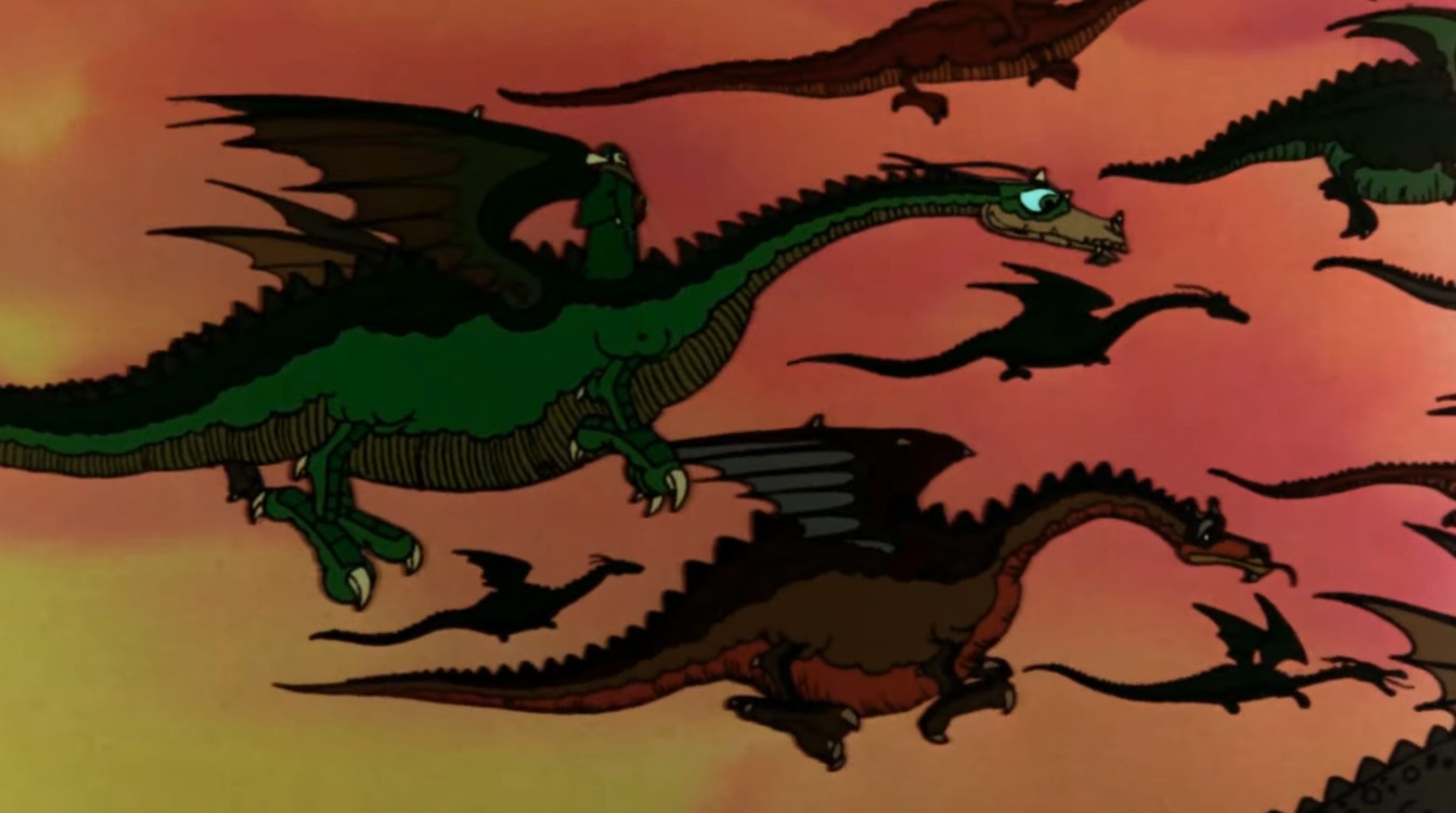
As a palate cleanser from all that sword & sorcery, and in our first (but not only!) return to the Rankin-Bass universe, this week I’ll consider The Flight of Dragons. This odd little animated movie is a kind of inspired mash-up of two dragon-themed works from the 1970s. It follows the adventures of thoroughgoing nerd Peter Dickinson (John Ritter) who accidentally splinches himself into the body of a dragon and with the help of his friends must defeat the evil wizard Ommadon (James Earl Jones), who is intent on hurling humanity back into the dark ages.
The Flight of Dragons: Gas, Acid, and Legends
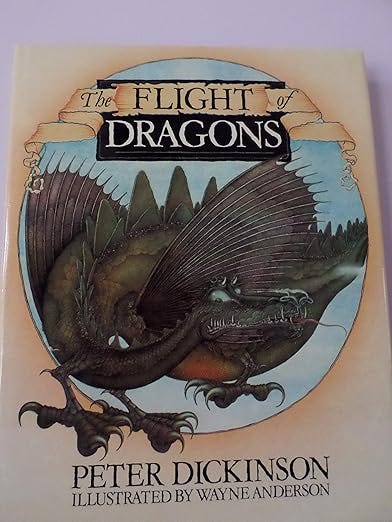
Before Arthur Rankin, Jr. and Jules Bass dubbed their cartoon-dragon protagonist Peter Dickinson, however, the real-life Peter Dickinson was a well regarded writer of both children’s and adult fiction, two-time winner of the Carnegie Medal and the Golden Dagger. His singular work of speculative natural history, The Flight of Dragons (Harper & Rowe, 1979), furnished with lavish illustrations by Wayne Anderson, sets out to unite tales about dragons across cultures into one unified, scientific theory about why and how they fly.
Drawing on physics, mathematics, and insect and avian biology, Dickinson theorizes that dragons’ wings are for steering rather than lift. Based on wing-size, dragons must be incredibly light and instead propelled by chemical reactions created within their bodies, which contain “a series of chemical retorts” woven throughout a honeycomb-like skeletal structure. Like giant birds, dragons swallow hard gemstones to store in their crop (hence all the raiding of dwarven treasure), and then eat calcium-rich limestone which the gemstones pulverize before passing it into the stomach. Once there, stomach acids react with the calcium to produce hydrogen gas that must be somehow expelled. He posits a concave structure in the roof of their mouth that produces an electric shock to ignite the hydrogen on its way out, thus producing fire as both a weapon and a means of controlling their descent. Because they are prone to belches and spontaneous eruptions of fire and acid, they must make nests of a non-flammable and chemically inert material: gold.1
Dickinson’s theory is far-ranging, explaining stories about dragons’ vulnerable underbellies (as quasi-dirigibles they’re extremely susceptible to puncture); and reconciling widely varying descriptions of dragons, including crawling, swimming, and flying specimens, as descriptions of different stages of the dragon lifecycle — female dragons make their homes in water, emerging only to mate, while male dragons only develop the size required for lift as adults after a long period of juvenile crawling.2 Dickinson reveals quite a lot of reading from medieval sources, including the Anglo-Saxon Chronicle, Jordanus Catalanus’ Marvels of the East, the Mabinogion, Beowulf (for which he provides his own translations and some interesting takes), and several sagas, combining them with Chinese dragon stories (particularly the Zhou emperors’ dragonish origin story) as well as accounts from fantasy writers like Tolkien, le Guin, Andrew Lang, and also Hugo award-winning science fiction author Gordon R. Dickson, who authored the other work that underlies Rankin-Bass’ Flight.
The Dragon and the George: Escaping Adjunct Hell the Hard Way
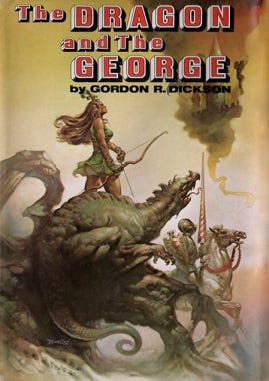
Rankin-Bass almost immediately acquired the rights to Dickinson’s book, but according to Dickinson they were flummoxed by its lack of plot. Their solution was to combine it with Gordon R. Dickson’s novel The Dragon and the George (Doubleday, 1976), whose premise the movie follows loosely but recognizably - a modern academic, transposed into the body of a dragon, out on a wizard’s quest with his loyal companions.3 The book tells the story of Jim Eckert, a recently graduated (and inevitably underemployed) Medieval History PhD, and his girlfriend, biology grad student Angie. As a not-so-recently graduated medieval historian myself, I enjoyed (?) all the asides about how broken academia, and particularly medieval academia, is (and this was written during the ‘70s, oy). While waiting for Angie to extract herself from the lab, pre-dragon Jim resigns himself:
He had to learn to live with the whole business of selfish department heads, inadequate salaries and an economy that was pinching Riveroak College here, like all other educational institutions, to the point where it seemed that about all you could do with a doctorate in medieval history was use the diploma to shine your shoes, before going to apply for a job as a grain shoveler—4
The truth hurts! His frustration revolves around a promised lectureship that failed to materialize when a craven department head reneged on his promise. This leaves him with a teaching assistant’s meager salary, looking at lodgings in a trailer park:
Some of the dreary grittiness of the mobile home seemed to blow through his soul on a bleak wind of despair. For a moment he felt a sort of desperate hunger for the kind of life that had existed in the European Middle Ages of his medievalist studies. A time in which problems took the shape of flesh-and-blood opponents, instead of impalpable situations arising out of academic cloak-and-dagger politics.5
I mean, I feel the bleak wind of despair and all, but I don’t have the upper body strength for flesh-and-blood opponents. His qualifications also sound hilariously unconvincing:
As a medievalist, Jim could both speak and read Middle and Old English, and with a doctorate he could also read and make himself understood in modern French and German. In addition to these languages, he had a smattering of modern Spanish, a few words of modern Italian, and a good knowledge of all the Romance languages in their medieval forms. Finally, he could read both classical and medieval church Latin with facility, and work his way through classical Greek with the help of dictionary in that language.6
Sure, Jim. He’s also described as a semi-professional volleyball player. As it happens, none of this does him any good as a dragon.
Dragon Gas: Rankin-Bass Edition
The genius of Rankin-Bass, then, was pulling these two threads together into a pretty satisfying whole, stamped with their own unmistakeable look. Flight shares the Rankin-Bass Tolkien films’ lush, quasi-watercolor quality; this was also a Topcraft production helmed by Toru Hara. Per Dickinson’s theory, the dragons are indeed blimp-like, and their wings flap very little. The “house dragons,” as they are known, are pretty charming, particularly the elderly, gregarious Smrgol (James Gregory) and his impetuous nephew Gorbash (Cosie Costa), who also appears as a truly adorable newly hatched dragon baby. And while the score isn’t as elaborate, the opening theme “Flight of Dragons” sung by Don McLean is gently compelling and mystic in a folksy vein reminiscent of Glenn Yarborough’s in the Tolkien films.
Rankin-Bass’ innovation is their creation of the character Peter Dickinson, a struggling academic and erstwhile scientist who has funneled his passion for dragons into creating a DnD-style board game, as well as a book on the theory of dragonflight. The real Dickinson noted with bemusement that they never asked him before doing this:
“The film seems to get shown pretty well every Christmas. Scraps of my theory crop up here and there, and the hero is named Sir Peter Dickinson (nobody asked me, of course) but that’s all I have to do with it. I don’t even make any money out of these repeats, but I bear no grudge. I’d still earned more from my silly little pamphlet, before the crash, than I’d done till then from any of my other books. OK, life is unfair, but not always to one’s own disadvantage.”7
Unlike in Dickson’s novel, where being a dragon is apparently totally intuitive (it must be Jim’s volleyball skills), in the film Smrgol must teach Peter how to dragon, with middling results as in the clip above. I love everyone’s undermining reactions to Peter’s nerdy and ineffectual ways as both human and dragon — from Gorbash exclaiming “That’s going to be our leader?” while watching him play his dorky board game, to the pink dragon Lunarian shaking his silly pink head at dragon-Peter’s antics, to Smrgol’s muttering “Shut up and eat your limestone" to dragon-Peter as he diagrams the explanation of dragonflight while exclaiming with nerdy excitement. The dragons have so much shade and I am here for it.
For all the judgmental dragons, Flight returns to a theme we’ve seen before in medieval 1980s movies. The movie begins with a wizard summit in response to a growing crisis in the world of magic, called by Carolinus (Harry Morgan), the Green Wizard of the natural world. His brother Ommadon the Red, however, extols the destructive power of technology as it begins to pervade the world, and shows a positive glee in the certainty that humanity will not use it wisely (see clip below). While this sentiment mostly lurks in the background of “medieval” films, hinting at some cataclysm precipitating a new medieval age, Carolinus and Ommadon bring this front and center with a sequence showing magic’s power over the human world, as inspiration for abilities beyond humans’ wildest dreams (television, radio, airplanes) or nightmares (environmental depredation and warfare culminating in a chilling image of a mushroom cloud). I found it striking how the modern world seeps into the film, not just when Carolinus goes to find Peter in the present day (or when Peter returns there in the end), but here as well.
Science and magic, then, are double-edged swords. Ommadon’s desire to inspire humanity down a path to its own destruction is counterposed against his eventual, ridiculous defeat by Peter, who literally just shouts scientific formulae and disciplines at him until he shrivels into nothingness. But where Excalibur for example showed the world of science eradicating the world of magic, Flight offers a more optimistic take: the worlds can and must exist side by side, and magic must remain for modern people to call upon when they need it most. Even (especially!) if that magic looks like a friendly, gassy dragon.
Peter Dickinson, The Flight of Dragons (Harper & Rowe, 1979), 22, 27-33; 93-100.
Dickinson, Flight, 57-73.
The novel is in turn based on Dickson’s 1957 novella “St. Dragon and the George.” It’s the first in the Dragon Knight series (1976-2000).
Gordon R. Dickson, The Dragon and the George (Doubleday, 1976), 2.
Dickson, Dragon, 8.
Dickson, Dragon, 36-37.
“The Flight of Dragons,” Peter Dickinson Books, copyright 2024, accessed September 5, 2025, https://www.peterdickinson.com/books/flightofdragons.